
Five Questions for Bob Walsh ’90, St. John’s Assistant Basketball Coach
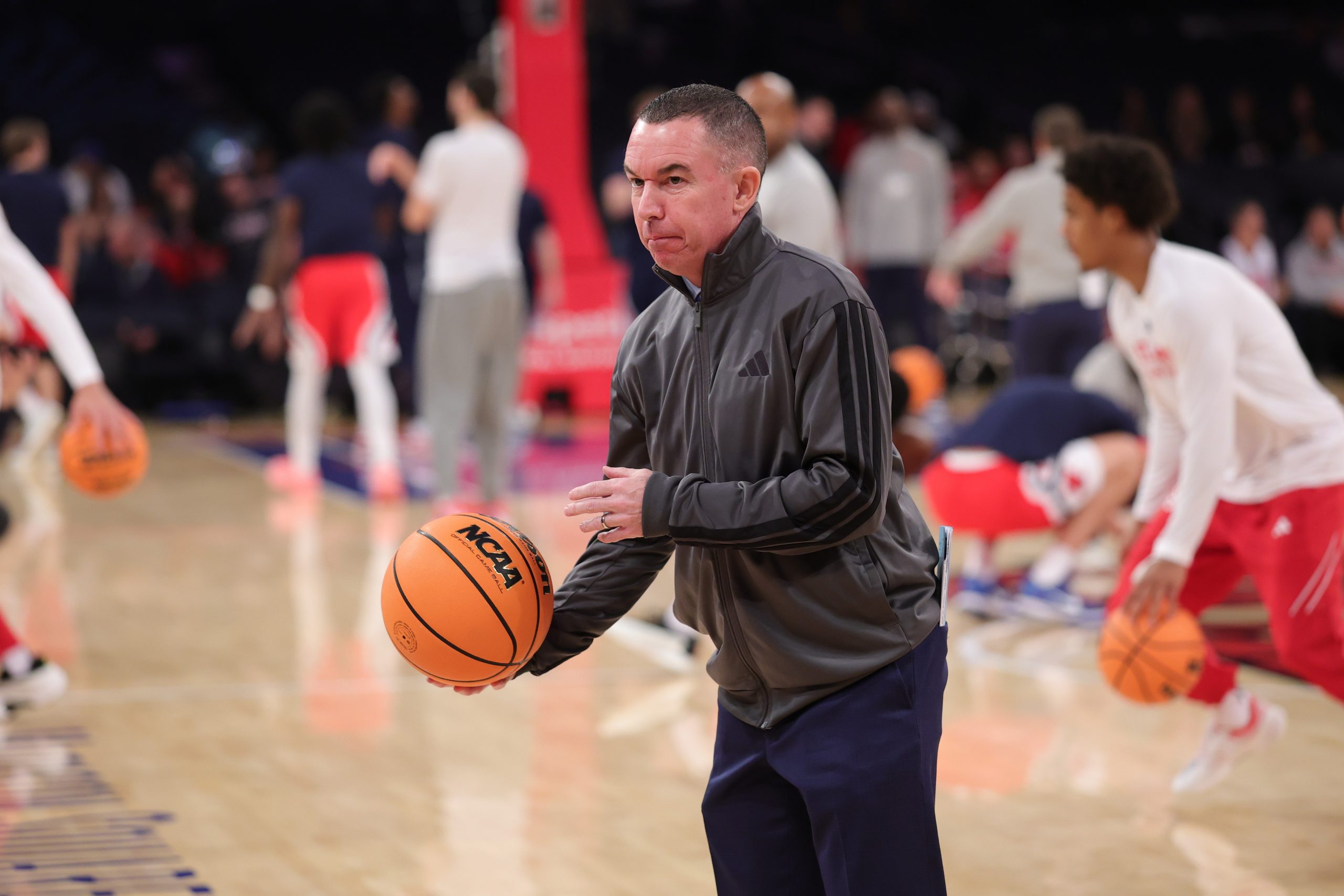
The Regis alumnus on his team's back-to-back Big East championships and the state of college hoops.
When did you first know you wanted to go into coaching?
I knew in high school. I was always an athlete, and I knew I wanted to be a part of athletics. I wanted to play as long as I possibly could, but I also knew I wasn’t going to be doing that for a living. If I could play in college, great. If not, that was going to be the end of it. And I was always sort of attracted to being a part of a team and the things high-performing teams have to do to connect together.
Basketball was my favorite sport to play, even if I was a bit better at soccer and at baseball. When I was in high school, a bunch of Regis guys used to go to a basketball camp in the Catskills, run by the coach at All Hallows, called the Shamrock Basketball Camp. I’ll never forget, during my evaluation as a player, my coach said, ‘Bob, you’re going to make a great coach.’ He meant it as a joke, but I guess I kind of had that approach and that attraction to leadership.
What was your first step towards college coaching?
I went to Hamilton College because I knew if I was going to continue playing beyond high school, it was going to be at the Division III level. Plus, they had a JV program, so I knew I could be involved in the program there somehow. I played two years on the JV team, and then I realized after my second year that there was a younger point guard who was better than me, and I thought that might be a good time to start the coaching thing. So I became a student assistant to the JV team while I was in college.
While there I also met someone who helped me out a lot. Kyle Smith, who was two years older than me, was the starting point guard at Hamilton. He’s now the head coach at Stanford. After college, I was able to get a grad assistant position working for the sports information director at Iona, near where I grew up. In my free time, I went over to the basketball office and said, ‘Hey, can I help out?’ Then a couple of years later, Kyle, who was kind of my big brother and one of my roommates in college, got a job at the University of San Diego. I was working the camp circuit, which is kind of what you have to do to get to know coaches, and I learned they had a position open. I got the job, and that was my first Division I experience as an assistant coach.
How did you first meet St. John’s head coach Rick Pitino?
Jerry Welsh was the head coach at Iona, and his son Tim took over for him while I was a grad assistant there. Tim had some success there and was hired at Providence, then asked me to go with him. I was an assistant coach in the Big East when I was 26 years old. I was there until 2014, when I got the head coaching job first at Rhode Island College, and then at the University of Maine.
But while I was an assistant at Providence, Rick’s son Richard was a student there. I got to know Richard during that time period, and our relationship remained as he got into his own coaching career. When Rick was coaching at Iona, Richard called me and said, ‘Hey, my dad is looking for a veteran assistant, and just a heads up, he’s going to call you.’ It was a full circle moment. I grew up at Iona. Both my parents went there, I went to basketball camp there, and my family had season tickets.
How has the job of a coach changed in today’s college basketball landscape?
As an assistant coach, I do a lot of things: working out on the floor with our guys, doing film work, planning practices. Then there’s the non-basketball side of it. You’re making sure guys are doing what they’re supposed to be doing academically. You’re building relationships with guys to understand what makes them tick and push them to the highest level.
And then there’s recruiting, which has changed a lot. The players have a lot more freedom and a lot more power. Once they enter the transfer portal, they can transfer as many times as they want. So now for the most part, at the highest level, you’re recruiting college kids. You’re not recruiting high school kids. Obviously, there are still some elite high school kids out there, but when you’re talking about an 18-year-old who has a chance to be very good versus a 20- or 21-year-old who has played Division I basketball for two or three years and has produced at a high level, it’s easier to project what that 21-year-old is going to do to help you.
There are also a lot of agents now, and you’re talking to them about what a player’s price tag is going to be, because players are all able to make money now. So it’s a significant shift in what we do.
What does St. John’s basketball mean to the New York City sports scene?
When I was growing up, it was the heyday of the Big East Conference. I was actually a bit of a contrarian, because I was a Syracuse fan. But St. John’s was huge in the city. I remember going to the Garden for a St. John’s-Syracuse game with some of my classmates when I was at Regis. I just loved Big East basketball.
Now, we’ve won back-to-back Big East titles, and I see people in their 60s and 70s with tears in their eyes who care so much about St. John’s basketball. When St. John’s is successful, it brings a different energy to the city. When the Yankees are playing great, or the Mets, or the Knicks, obviously there’s an energy. But St. John’s fans are part of it in a different way. I’m a Yankees fan, but I was never a part of the Yankees organization. But St. John’s fans are the lifeblood of the school. It’s really, really cool.
This article appears in the Spring 2026 issue of Regis Magazine.
Read more Regis news