
Five Questions With Cancer Researcher Sandro Santagata ’89
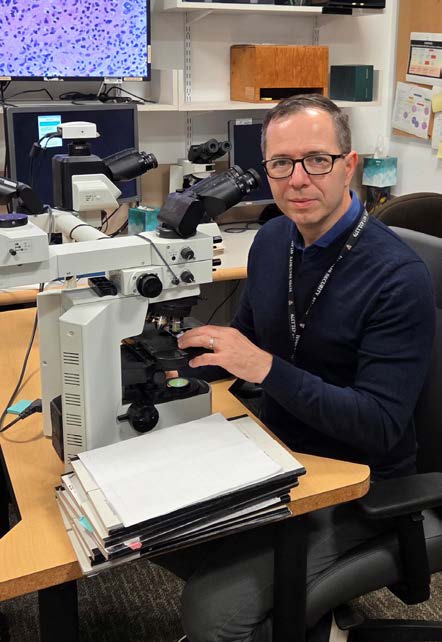
The associate professor of pathology at Harvard Medical School and pathologist at Mass General Brigham is doing vital research into cancer treatments and more.
When did you first know you wanted to do scientific research?
I think there were glimpses of it early on. I always think back about this moment in maybe the sixth grade of flipping through an encyclopedia and doing a project on the ear and being fascinated by the elaborate structure and by all those kind of things that are hidden inside of us. It’s this beautifully engineered machine, and things have to operate with incredible precision. I remember being really intrigued by the biology of that. Then at Regis, I found a way to really explore a range of topics with curiosity and to live more intellectually with ideas. So it was a gradual process of being fascinated by biology early on, learning how to ask questions at Regis, and then later on in college and medical school getting on the dual pathway of science and medicine at the same time.
How did you get into pathology?
I remember sitting in the library at Mount Sinai, where I did my MD/Ph.D program, and I was going through one of the diagnostic pathology books. I was flipping through the pages and looking at diseases that I could barely pronounce their names, even though I had quite a bit of medical training. It was exhilarating to have that experience, to read about the extraordinary richness of human disease. It was a two-volume book, with generations and generations of observations and scholarship. In these books you could read about patterns of diseases that people have recognized, and underneath those patterns are disease mechanisms that were partly defined and many still yet to be defined.
As a pathologist, you can have an immediate impact on patient care. You can determine whether a lesion is benign or malignant and help guide a person’s therapy. But then you can also do deeper exploration. There’s a high level of scholarship. You can use that tissue to make people’s lives better in the long term through scientific discovery.
Is there a particular breakthrough you’ve worked on that you’re most proud of?
I’m proud of a lot of small contributions along the way. In graduate school we found the genetic basis of an immunodeficiency disorder, basically how people’s immune systems fail genetically, a familial genetic disorder that leads to deficient immune activity. It was called Omenn Syndrome. It really gave me that first glimpse into how biological work can improve both diagnosis of diseases, categorization, and classification. It taught me that you can use scientific tools to pretty quickly have an impact on people’s lives.
Another thing that I’m particularly proud of is the ability to work on rare cancers. Not a lot of resources are placed behind these diseases. But you can study them, try to find vulnerabilities in those rare cancers, and then take medicines that are commonly used for other cancers and apply them to a rare cancer. There’s a rare brain tumor that we worked on that has the same genetic lesion as melanomas. We applied the drugs developed for melanoma to this rare cancer and had dramatic responses. These were cancers in a very delicate area of the brain, and surgery leads to many complications for the patient. So identifying a systemic therapy that was already available and FDA-approved for melanoma and repurposing it, that was very gratifying.
What are you focused on at the moment?
We work pretty intensely in a field called spatial biology. It builds on what we do as pathologists. So for over a century, pathology has relied on the idea that information is encoded in the organization of cells and human tissues. So if we look at human tissues under the microscope, we can classify tumors and start to learn about them. We take a small piece of tissue, we put it on a glass slide, and we stain it with a few different dyes, and underneath the microscope a trained pathologist can recognize the patterns and what the cells look like, how they’re arranged and the structures that they’re forming. Much of the basis of our diagnosis of human cancer and other diseases is really based upon looking at those tissues and those structures under the microscope. What’s changing now is that we’re doing a lot on both the technology and the biology side and can essentially take that same piece of tissue that we use for diagnosis, and we can use new techniques that our group helps develop. We can extract a lot of deep, deep molecular information without losing the geographical information.
Before we would just look at the tissue under a microscope. Now we can see tens, even hundreds of molecules within that same section of tissue and have this much deeper layer of data that we can use to start to learn about the geographic patterns of cancers, how the cells are communicating, and the molecules that they’re using to communicate.
Data analysis techniques are using machine learning and A.I. and a lot of sophisticated computation and really turning human tissue into a highly valuable resource for understanding how diseases happen, how they progress, and what kind of vulnerabilities we can exploit to treat cancer.
How optimistic are you for the future of cancer research?
I’m very hopeful, because I see all the activity with my colleagues and many, many, many others. We’re characterizing the properties of human tissues in ways that we never have been able to do before, and the insights are just getting better and better. Medicines are getting better — new breakthroughs in RNA vaccines, targeted therapeutics through cell-based therapies, new ways of targeting therapies more specifically to cancer cells. There’s been amazing progress over the last couple of decades, and I’m just very hopeful that we’re going in the right direction. Substantial progress has been made, and there’s a lot of interesting work to do. Looking at the future, there’s such a tremendous opportunity to do good in the world.
This article appears in the Fall 2026 issue of Regis Magazine.
Read more Regis news